
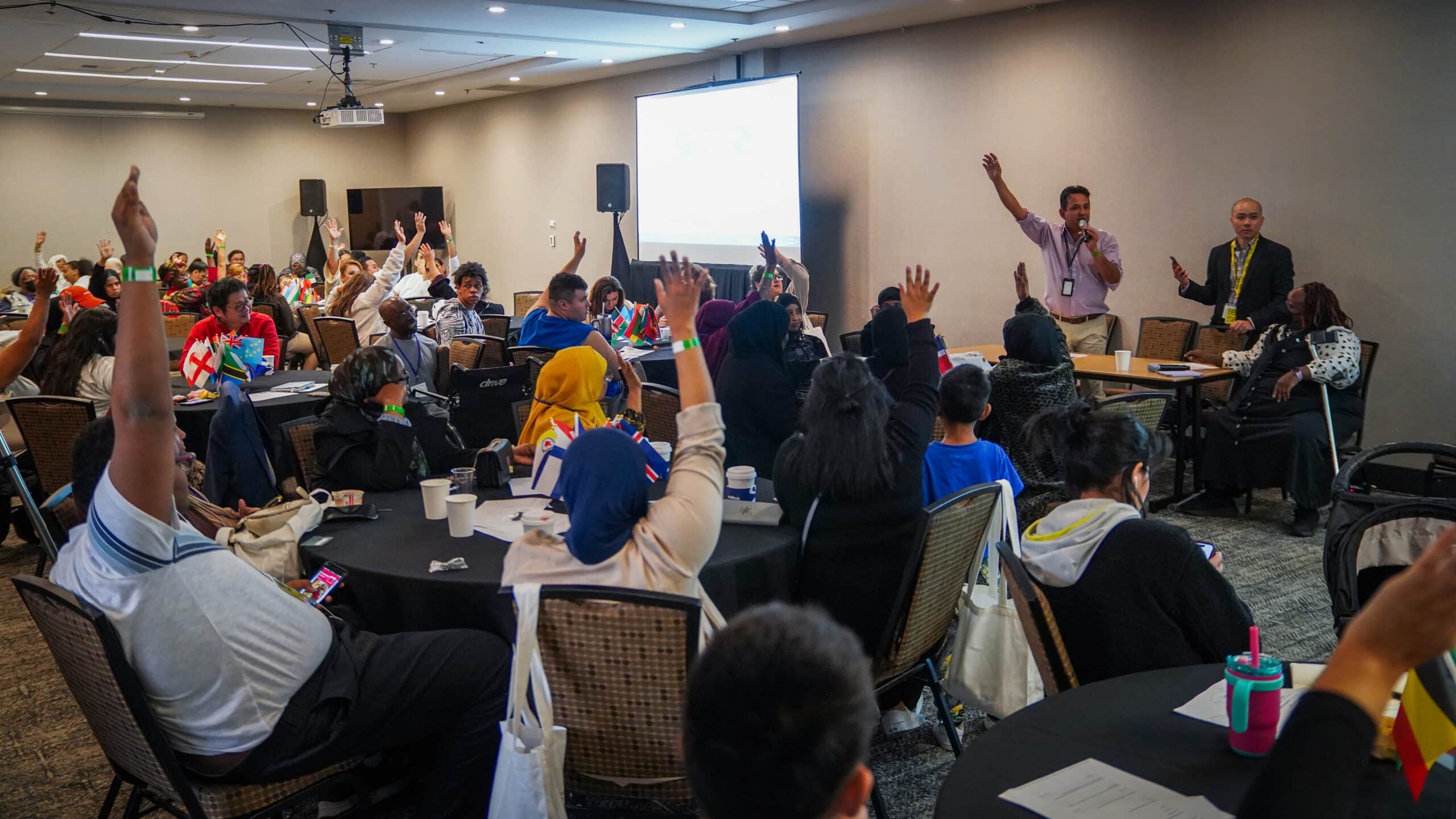
Open Door for Multicultural Families (ODMF) recently brought together families, community partners, advocates, and educators for a powerful day of learning, connection, and empowerment focused on supporting children with disabilities and their success in school and beyond. The event showcased what is possible when families are equipped with knowledge, resources, and a strong community network.
From the moment families arrived, the atmosphere reflected ODMF’s commitment to belonging, accessibility, and meaningful participation. Through interpretation support, childcare, lunch, participation stipends, and a supervised Kids’ Corner, barriers to engagement were reduced so families could fully participate, learn, and connect with one another.
This successful event was truly an all-hands-on-deck effort. ODMF staff stepped into multiple roles throughout the day, bringing their expertise, creativity, and dedication to ensure every family felt welcomed and supported. Their teamwork was instrumental in creating a seamless and inclusive experience for all attendees.
Building Parent Advocacy Skills
The day began with an engaging workshop led by Ginger Kwan and Evelyn Ayay, who guided families through the often complex Individualized Education Program (IEP) process. Parents learned practical strategies for advocating effectively for their children before, during, and after IEP meetings.
Topics included requesting evaluations, securing interpreter services, reviewing draft IEPs, developing SMART goals, understanding placement and related services, and navigating disagreements with school teams. Families left with concrete tools and increased confidence to partner with schools and advocate for the educational supports their children need to thrive.
Exploring the Power of Assistive Technology
In the second workshop, Diana Sanda introduced families to the many ways assistive technology can enhance learning, communication, and participation for students with disabilities.
Parents explored a variety of low-, mid-, and high-tech tools, including visual schedules, communication boards, adapted writing tools, text-to-speech and speech-to-text software, augmentative and alternative communication (AAC) devices, and built-in accessibility features available through everyday technology.
The impact extended beyond the workshop itself. Families received practical resources, including 10 visual schedules and 13 visual communication core boards, while additional parents connected with ODMF for future assistive technology consultations.
Supporting Positive Behavior at Home and School
The final workshop, led by Nicole Gorman, focused on understanding and supporting behavior through evidence-based practices. Families learned about the ABCs of behavior, Antecedent, Behavior, and Consequence, as well as the importance of sensory needs, environmental influences, observation, data collection, and positive reinforcement.
Together, the three workshops provided families with a comprehensive framework for advocating for their children, supporting learning, and strengthening overall family well-being.
Connecting Families to Community Resources
Beyond the workshops, families had the opportunity to connect with numerous organizations through a vibrant resource fair. Community partners included Roots2Wings Family Group, the Office of Education Ombuds, Envisioning Solutions for Employment (ENSO), Highline College’s Achieve Program, Essentials First, the Washington Developmental Disabilities Council, and multiple ODMF programs and services.
The event also reflected ODMF’s commitment to serving diverse communities. Thirty-six participants attended, representing families who speak Vietnamese, Spanish, Tagalog, Somali, Dari, Tigrinya, Amharic, Russian, Hindi, and English. Thirty-two families received participation stipends, helping ensure equitable access and reducing financial barriers to participation.
A Community Effort
Special guests included Washington State Representative Tina Orwall and Lauren Lee from the City of Seattle, one of ODMF’s valued funding partners. Lee conducted a program observation and expressed strong appreciation for the quality of the event and its impact on participating families.
Families Report Overwhelmingly Positive Experiences
Participant feedback demonstrated the event’s success in advancing ODMF’s pillars of belonging, community, inclusion, and family empowerment.
Survey responses showed:
- 94% of respondents completely agreed that the event was welcoming and that staff made participation easy.
- 91% completely agreed they gained useful information and learned something new.
- 100% agreed that the services and training were helpful and met their needs.
- 97% agreed they had opportunities to connect with other families.
- 97% agreed the event strengthened their knowledge and skills for their families.
- 100% agreed staff understood the challenges their families face.
Participants also reported increased connections to peers, family, culture, and community, as well as strong satisfaction with the accessibility of event materials and resources.
Creating Lasting Impact
The success of this event demonstrates the power of culturally responsive, family-centered programming. By bringing together expert training, community resources, peer connections, and practical supports, ODMF continues to create opportunities for families to build knowledge, confidence, and community.
As Safio Abdi, Associate Director of Programming and Advocacy Development, reflected:
“Overall, the IEP conference had a meaningful and lasting impact by helping ODMF meet families where they are and equipping them with practical tools, culturally responsive information, and direct connections to resources that support their children’s success.”
Participant feedback reinforced that impact. Families reported gaining valuable advocacy skills, learning new strategies to support their children’s development, and building stronger connections to both community resources and one another. Through workshops, resource sharing, and meaningful engagement, the conference embodied ODMF’s commitment to inclusion, belonging, and family empowerment.
Most importantly, families left knowing they are not alone. They left with new skills, stronger connections, valuable resources, and a deeper sense of belonging. These outcomes not only support children in their educational journeys today, but also help strengthen families and communities for years to come.